With these tires my experience is rooted in the physics of the contact patch and the trade-offs we make in the design phase. Simply put here, Toyo R/T Trail is built to withstand concentrated impact forces, and the Open Country AT3 is built for consistent harmonic dampening and surface adhesion.
With the RT Trail, the “void-to-lug” ratio offers extreme off-road conditions. You need that high negative profile in the tread to create mechanical locks in soft soil and rock crevices. The trade-off, however, is that those big voids can sometimes feel vague on pavement. That’s where the AT3 comes in and provides that thermodynamic stability. The tire is engineered with rubber compound to remain pliable in freezing temperatures (3 peak rating), and the symmetrical, interlocking lug design minimizes tread squirm. This reduces the coefficient of rolling resistance so you get fuel efficiency and long-term even wear.
Now if you wish to go in further, I think it would be better if you check their dedicated reviews out first. Here is the Toyo Open Country R/T Trail, and here is its little bro the Toyo AT3.
Side Note: I’ve heard that Toyo AT4 is going to come out. If you hear any news please let me know in the comments.
So, Which One Should You Pick?
If you are being honest with yourself about how much mud you actually see, the choice gets pretty simple.
Choose the Toyo Open Country RT Trail if:
You play in the rough stuff. The RT Trail is built for mud, rocks, and deep sand. Its big tread voids and 3-ply sidewalls mean you can bounce off rocks without worrying about a puncture.
You want the “aggressive” look. Let’s be real, the stance matters. The RT Trail has that chunky, rugged shoulder that fills out a truck fender perfectly.
And Stick with the Toyo Open Country AT3 if:
You drive in the rain and snow. This is the only tire here with a Three-Peak Mountain Snowflake (3PMSF) rating. It handles a snowy commute or a wet highway far better than its bigger brother.
You care about road manners. The AT3 is quieter, lighter, and will save you a few bucks at the pump over the life of the tire. It also comes with a longer treadwear warranty for a reason.
Tread Design Philosophy
When you put these tires side-by-side, the design goals become immediately obvious.

The Toyo AT3 is all about contact.
As you can see, it’s tread blocks are packed relatively tight.
Those S and F-shaped center blocks are covered in “3D sipes”
Those little wavy slits in the rubber. They aren’t just for show; they interlock to provide stability on the highway while still biting into snow.
The shoulder blocks are connected by small ridges, which is a clever trick to block road noise, though it does mean the tire doesn’t clean out mud as fast as some others.

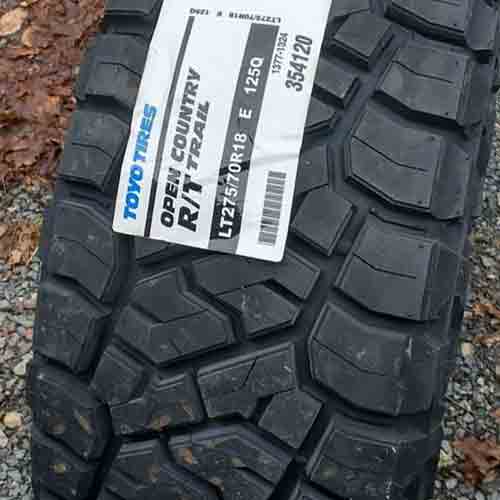
The Toyo RT Trail takes a different approach. It is more aggressive. The voids between the tread blocks are much larger because they aren’t worried about noise as much as they are about mud evacuation.
Overall as you can see its design is straightforward. You get those big, sturdy blocks with notches cut in every direction to grab onto rocks.
And of course the sidewall lugs are much more aggressive here, which is a huge help when you air down on the trail.
Sizes and Specs
Before we get too deep into the performance weeds, it helps to know what you are actually buying. These are two very different animals in terms of construction.
Toyo Open Country R/T Trail
- Wheel sizes: 16″ to 24″
- Total options: 47 sizes
- Construction: LT sizes feature a heavy-duty 3-ply sidewall. P-metric sizes are 2-ply.
- Tread depth: 13.5 to 16.9/32″ (pretty deep)
- UTQG: 600 A B (good for a hybrid tire)
- Warranty: 45,000 miles
- 3PMSF Rating: No (M+S only)
Toyo Open Country AT3
- Wheel sizes: 15″ to 22″
- Total options: 148 sizes (massive range)
- Construction: 2-ply sidewalls across the board.
- Tread depth: 12.7 to 17/32″
- UTQG: 600 A B
- Warranty: 65,000 miles
- 3PMSF Rating: Yes (on all sizes)
Dry Handling and Steering Feel
Hop in your truck and take a corner. The difference here is immediate.
The AT3 feels planted. Because the tread blocks are reinforced at the base and packed closely together, the tire responds to your steering input instantly.
There is a nice, solid “on-center” feel, meaning you aren’t constantly making tiny corrections on the highway. It just tracks straight.
The RT Trail, by comparison, feels a bit more like a truck tire. It is heavier (by as much as 26 lbs per corner in larger sizes) and the taller, more flexible tread blocks introduce a slight delay in steering response.
It isn’t dangerous by any means, but you will notice a bit of squirm. You turn the wheel, the truck thinks about it, and then it turns. This is the trade-off for a tire that can handle rocky terrain.
Wet Roads and Rain
This is where the AT3 pulls ahead significantly.
Wet traction is a game of water displacement. The AT3 uses its dense network of sipes to wipe the water film off the road.
However, it has a slight weakness: those ridges connecting the shoulder blocks (the ones that make it quiet) actually trap water a bit, preventing it from escaping out the sides of the tire as fast as it could.
It is still a very capable tire in the rain, but if you live in the Pacific Northwest, you might want to check out how it stacks up against the competition.
For example, the Falken Wildpeak AT3w is often considered the gold standard for wet performance in this category. And surprisingly its better than Wildpeak AT4W.
I think a better comparison would be between Toyo R/T Trail and the Wildpeak R/T.
The RT Trail struggles more here. The rubber compound is stiffer to handle off-road abuse, which means the sipes don’t flex open to “suck” water off the road as effectively. In a heavy downpour, you will want to slow down sooner in the RT Trail than you would in the AT3.
Winter and Snow
Here is the deal with snow. If you are driving on packed snow and ice on your way to the ski resort, you want the AT3.
That 3PMSF rating isn’t a sticker; it means the rubber compound stays flexible in freezing temperatures. The tread design is also optimized for “snow-on-snow” traction, meaning the grooves are shaped to hold snow, because snow sticks to snow better than rubber sticks to snow.
The RT Trail is better suited for deep, fluffy stuff. If you are breaking trail through a foot of fresh powder, the open tread is great.
But on a frozen highway, that open tread reduces the contact patch and makes the truck feel a bit loose. You get a lot of oversteer if you are not careful.
Noise and Comfort
If you spend a lot of time on the highway, this might be the deciding factor.
Tire noise is mostly air being compressed and released in the tread grooves. The AT3 is engineered to be quiet. Those ridges I mentioned earlier act as a dam, blocking air from rushing into the grooves. It is one of the quieter all-terrain tires you can buy.
The RT Trail hums. It isn’t as loud as a full-blown Mud-Terrain, but you will hear it. Toyo did a good job with the “pitch sequencing” (varying the size of the tread blocks to scatter sound frequencies), but you can’t cheat physics.
Bigger voids mean more noise. For a deeper dive on why this happens, check out this article on why all-terrain tires are noisy.
Longevity and Fuel
Both tires share a UTQG rating of 600, which is a measure of treadwear. In theory, they should wear at a similar rate on a light vehicle.
However, in the real world, the AT3 lasts longer for two reasons. First, it is lighter. A lighter tire puts less stress on itself as it deforms and rebounds at highway speeds. Second, the stiffer tread blocks generate less heat. Heat is the enemy of rubber; it accelerates wear.
The AT3’s fuel economy is better for the same reason, less energy is wasted deforming the tire. (If you are curious about how they measure this stuff, here is a guide to UTQG ratings).
Off-Road: Mud, Rocks, and Sand
Mud
Mud is all about self-cleaning. If the tire fills up with mud and can’t throw it out, you become a passenger on a sled.
The RT Trail wins here easily. The massive voids in the tread give mud a place to go and a path to eject. The staggered shoulder blocks act like paddles, scooping mud backwards to propel you forward.
The AT3 packs up with mud quickly. Those tight grooves are great for pavement, but in thick clay or mud, they become packed solid, turning your aggressive tire into a slick.
Rocks
On the rocks, durability is king. The RT Trail is the clear winner thanks to its 3-ply sidewalls. You can rub against sharp edges without worrying about slicing a hole in your tire. The sidewall lugs also give you something to grip with when you air down.
The AT3 has weaker 2-ply sidewalls. While the tread face grips well thanks to all those notches, the sidewall is vulnerable. If your off-roading involves rock crawling, the RT Trail is the safer bet.
Sand
Sand is about flotation. You want to paddle, not dig.
Both tires do well here, but the RT Trail has a slight edge. Once you air down, the longer sidewall and aggressive shoulder lugs create a wide paddle surface. The lateral orientation of the center blocks helps thrust you forward through soft dunes.
The Bottom Line
So, here is the truth.
If your truck is a daily driver that sees dirt roads, snowy commutes, and the occasional camping trip, buy the Toyo Open Country AT3. It is quieter, better in the rain and snow, and will save you money on gas and tires in the long run. It is one of the best all-rounders on the market. (You can see where it ranks in my list of best all-terrain tires).
If your truck is a weekend warrior. If you seek out mud holes, rock crawl on the weekends, and don’t mind the highway hum because the music is loud enough, buy the Toyo Open Country RT Trail. It is a legitimate hybrid tire that brings Mud-Terrain capability without being completely unlivable on the street.
Choose the tool that fits the job.
