Ozmen photo

Tire reviews & comparisons

Ozmen

Hi Folks. I'm Ozmen, and I work as a tire designer. I understand finding a tire isn't easy, as there are so many variables involved. But with me around, tire selection would never bother you again.

Air Pressure Guide For All-Terrain Tires

Air Pressure Guide For All-Terrain Tires

When it comes to all-terrain tires, air pressure plays a crucial role in ensuring safety and performance on different types of terrain such as rocks, mud, sand, gravel, and paved roads. And according to my experience, on rocky terrains, consider keeping air pressure between 18 and 22 PSI. For mud, 17 to 20 PSI, and for sand, below 16 does great. But make sure you know your tires first, and their capability along with size and everything. You can contact me for more help.

Falken Wildpeak AT3w on sand

Are All-Terrain Tires Good On Sand?

The whole point on sand is to keep tires floating as much as possible, and to do that, tires should be lighter, capable of running lowered air pressure, have softer tread composition and provide thick enough sidewall lugs. And considering all these factors, all-terrain tires don't look so bad. And some of the tires like the Falken Wildpeak AT3w provide ample traction in that area. Check out all the A/T tires: https://tiredriver.com/all-terrain-tires/

All-Terrain Tires Cause Vibrations

Do All-Terrain Tires Cause Vibrations?

When it comes to al-terrain tires, you can expect some limited comfort overall, as their more number of plies internally causes an overall stiffness, resulting in less absorption of vibrations in the tread. Moreover, with bigger grooves, especially on aggressive A/T tires, the tread isn't able to make a consistent contact with the smooth surface, and this causes the ride to get bumpier. But as A/Ts come in a large variety, there are some tires which are actually pretty great at cushioning the bumps, and out of them, the Yokohama G015 ranks on top.

All-Terrain Tires Good In Snow

Are All-Terrain Tires Good In Snow?

All-terrain tires are not so bad when it comes to overall winter performance, and that's the reason why they get to have 3 peak mountain snowflake ratings in almost all of them. Though they can never be better compared to dedicated winter tires, that's for sure. Read Next: https://tiredriver.com/all-terrain-tires/

All-Terrain Tires Good On Mud

Are All-Terrain Tires Good On Mud?

Overall all-terrain tires can do pretty bad when it comes to mud. But still there are some tires that aren't too off. These tires offers wide enough tread voids and good tread depth, along with staggered shoulders and sidewall lugs. And they all work in combination to provide ample mud traction. Though keep in mind, these tires can not act as an alternative to mud-terrain tires, as they are much more aggressive and offer better features comparatively.

Off-Road Tires

What are Different types of Off-Road Tires?

It has always been a long lived war between on-road comfort and off-road capability. Improve one and the other goes down. That's why as the off-road tires get to become more and more aggressive, they start losing their on-road abilities. Though you can still choose according to your needs. If you want an off-road tire but going to use them on roads mostly, go with all-terrain tires. If you need superior off-road performance and don't care too much about on-road comfort go with mud-terrain tires. Want something in the middle? Get the middle one, Rugged terrain. And on the extreme ends, you have ATV tires, which only prefer to live on rugged tracks rather than smooth pavements.

LT Mean On A Tire

What Does LT Mean On A Tire?

So basically Light Truck (LT) tires are made for carrying higher load and handle rougher terrains compared to P metric sizes. That's why these tires are ideal for heavy-duty vehicles such as SUVs, vans, and pickups. Their reinforced sidewalls can handle additional stress of off-road driving and with a larger contact patch (carrying heavier weight), they provide the needed stability and along with it safety. Though keep in mind, that these tires are not as budget friendly in comparison, and speaking of which, with them you also spend more on fuel, as they generate larger rolling resistance values.

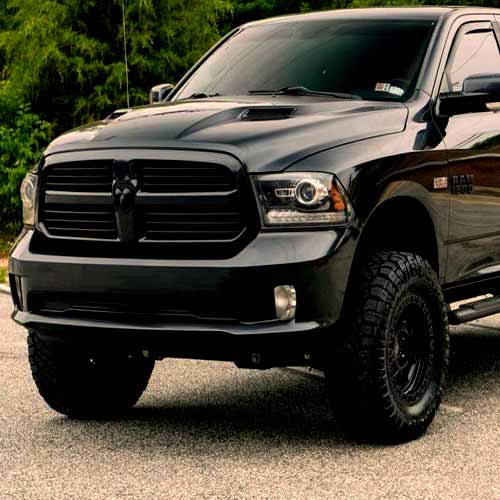
All-Terrain Tire on RAM

All-Terrain vs All-Season Tires

Compared to all-terrain, all season tires aren't able to provide good enough traction on mud, sand, rocks, or even gravel, that's because they don't have the needed durability, nor their tread pattern has biters on them. Whereas A/T tires give you powerful full depth notches everywhere, and these grip the rough terrains from all directions. Moreover, with powerful stone ejectors and wider grooves, these tires are better at self cleaning. But on pavements, all-season tires are much more reliable comparatively, as with them, you get a better steering response, wet traction and overall comfort.

common all-terrain tire size

What is the most common all-terrain tire size?

265/70R17 is the most common all terrain tire size. Though keep in mind that there are a lot of factors contributing to that. And in order to explain them all, I've talked about section width, aspect ratios, and rim sizes and how they affect the overall performance.

Mud-Terrain Tire

Difference Between Mud-Terrain And All-Terrain Tires?

All-terrain tires are better suited for driving on paved roads and in all-season conditions, with superior performance on wet and snowy roads, as they offer closed up rib placements and shoulder lugs that provide more stable lateral/directional traction and steering response. Mud-terrain tires, on the other hand, are better suited for off-road conditions, particularly in mud, with wider combination of lateral and longitudinal grooves, and thicker sidewall lugs that provide better traction on rocky, sandy and muddy terrain. Moreover, they are more durable with 3-ply sidewalls and Kevlar reinforcements, and have deeper tread depth. Though they are also very louder, and their heavier built make them uncomfortable on roads. And yes, these tires also don't get to have ample speed ratings, or sever winter ratings like the 3pmsfr (though they do have M+S).

All-Terrain Tire Fuel Usage

Do All-Terrain Tires Get Worse Gas Mileage?

When it comes to all-terrain tires, although you do have to compromise a little in the fuel efficiency department, compared to on-road tires, you can reduce the gap by choosing more on-road oriented design. Some all-terrain tires are just more streamlined towards highways, and they don't use as much of the fuel as the other aggressive options. These tires include some great option, and out of them, the best for fuel is Firestone Destination A/T2. Read Next: https://tiredriver.com/all-terrain-tires/

All-Terrain Tires For Daily Driving

Are All-Terrain Tires Good For Daily Driving?

So basically all-terrain tires can be really great when it comes to daily driving. As these give you with all season traction having 3 Peak Mountain Snowflake ratings, and they also don't disappoint on roads with their good enough comfort, traction and steering response. And off-road you get all the durability and crawling capability, if your daily driving needs it.